Mohr 원
평면응력의 좌표변환과 Mohr 원
Contents
1. 좌표 변환 행렬 복습
- ($\boldsymbol e_1,\boldsymbol e_2,\boldsymbol e_3$)로 이루어진 좌표계로부터 ($\tilde{\boldsymbol e}_1,\tilde{\boldsymbol e}_2,\tilde{\boldsymbol e}_3$) 좌표계로 변환하는 좌표변환 매트릭스(coordinate transformation matrix)는 아래와 같이 정의된다.
\[R_{ij}=\tilde{\boldsymbol e}_i \cdot \boldsymbol e_j \text{ with } i=1,2,3,\ \ \ j=1,2,3\] - 두 좌표계의 축들 사이의 내적을 사이에 끼인 각을 활용해 나타낼 수 있다. 즉, \(\tilde{\boldsymbol e}_i\) 와 \(\boldsymbol{e}_j\) 사이의 끼인각을 $\theta_{ij}$ 라 하면, 아래와 같은 관계식을 얻을 수 있다.
\[\cos\theta_{ij} |\tilde{\boldsymbol e}_i| |\boldsymbol e_j|=\tilde{\boldsymbol e}_i \cdot \boldsymbol e_j \text{ with } i=1,2,3,\ \ \ j=1,2,3\] - 그런데, 좌표축의 크기가 모두 1인 unit vector로 이루어진 직각 좌표계라 한정 지으면 위 식은 아래가 되며
\[\cos\theta_{ij} =\tilde{\boldsymbol e}_i \cdot \boldsymbol e_j \text{ with } i=1,2,3,\ \ \ j=1,2,3\] 따라서, 좌표 변환 매트릭스는 $\cos \theta_{ij}$로 이루어져 있음을 알 수 있다.
\[[\boldsymbol{R}] = \begin{bmatrix} \cos\theta_{11}&\cos\theta_{12}&\cos\theta_{13}\\ \cos\theta_{21}&\cos\theta_{22}&\cos\theta_{23}\\ \cos\theta_{31}&\cos\theta_{32}&\cos\theta_{33}\\ \end{bmatrix}\] 2. 평면 응력상태의 좌표 변환
- $\boldsymbol e_3$ 축으로 방향이 매우 얇은 판재를 가정하고 따라서 plane stress 상태라면, 응력상태는 아래 $2\times2$ 행렬로 표현할 수 있다.
\[[\boldsymbol\sigma]_{\boldsymbol e}= \begin{bmatrix} \sigma_{11} &\sigma_{12}\\ \sigma_{12} &\sigma_{22}\\ \end{bmatrix}\] - 좌표 변환 매트릭스의 경우, $\boldsymbol e_3=\tilde{\boldsymbol e}_3$으로 고정된 경우,
\[[\boldsymbol{R}] = \begin{bmatrix} \cos\theta_{11}&\cos\theta_{12}&0\\ \cos\theta_{21}&\cos\theta_{22}&0\\ 0&0&1\\ \end{bmatrix}\] 이 되고, 이는 응력과 마찬가지로 $2\times2$행렬로 축약하여
\[[\boldsymbol{R}] = \begin{bmatrix} \cos\theta_{11}&\cos\theta_{12}\\ \cos\theta_{21}&\cos\theta_{22}\\ \end{bmatrix}\] 가 된다. 그런데 먄약 $\theta_{11}$를 기준이되는 회전된 각도 $\theta$라 하면
\[[\boldsymbol{R}] = \begin{bmatrix} \cos\theta&\cos{(90^\circ-\theta)}\\ \cos(90^\circ+\theta)&\cos\theta\\ \end{bmatrix} = \begin{bmatrix} \cos\theta&\sin{\theta}\\ -\sin\theta&\cos\theta\\ \end{bmatrix}\] - 자 이제, 랭크 2 텐서의 좌표 변환법칙을 적용해보자. $\tilde{\boldsymbol e}i$ 축으로 표현된 응력 성분을 $\tilde{\sigma}{ij}$라 하면, 다음과 같이 주어진다.
\[\tilde{\sigma}_{ij} = \sum_k^2\sum_l^2 R_{ik} R_{jl} \sigma_{kl}, \text{ with } i=1,2\ \ \ j=1,2\] - $\tilde{\sigma}_{11}$: \(\tilde{\sigma}_{11} = \sum_k^2\sum_l^2 R_{1k} R_{1l} \sigma_{kl}\)
\[=R_{11} R_{11} \sigma_{11}+R_{11} R_{12} \sigma_{12}\] \[+R_{12} R_{11} \sigma_{21}+R_{12} R_{12} \sigma_{22}\] \[=\cos\theta \cos\theta\sigma_{11}+\cos\theta\sin\theta\sigma_{12}\] \[+\sin\theta\cos\theta\sigma_{12}+\sin\theta\sin\theta\sigma_{22}\] \[\therefore \textcolor{red}{\tilde{\sigma}_{11}=\cos^2\theta \sigma_{11} +\sin^2\theta\sigma_{22} +2\cos\theta\sin\theta\sigma_{12}}\] \[\tilde{\sigma}_{22} = \sum_k^2\sum_l^2 R_{2k} R_{2l} \sigma_{kl}\] \[=R_{21} R_{21} \sigma_{11}+R_{21} R_{22} \sigma_{12}\] \[+R_{22} R_{21} \sigma_{21}+R_{22} R_{22} \sigma_{22}\] \[=\sin^2\theta\sigma_{11}-\sin\theta\cos\theta\sigma_{12}\] \[-\cos\theta\sin\theta\sigma_{12}+\cos^2\theta\sigma_{22}\] \[\therefore \textcolor{red}{\tilde{\sigma}_{22}= \sin^2\theta\sigma_{11}+\cos^2\theta\sigma_{22}-2\sin\theta\cos\theta\sigma_{12}}\] \[\tilde{\sigma}_{12} = \sum_k^2\sum_l^2 R_{1k} R_{2l} \sigma_{kl}\] \[=R_{11} R_{21} \sigma_{11}+R_{11} R_{22} \sigma_{12}\] \[+R_{12} R_{21} \sigma_{21}+R_{12} R_{22} \sigma_{22}\] \[=-\cos\theta\sin\theta\sigma_{11}+\cos^2\theta\sigma_{12} -\sin^2\theta\sigma_{12}+\sin\theta\cos\theta\sigma_{22}\] \[=(\sigma_{22}-\sigma_{11})\cos\theta\sin\theta+\sigma_{12}(\cos^2\theta-\sin^2\theta)\] \[\therefore \textcolor{red}{\tilde{\sigma}_{12}=(\sigma_{22}-\sigma_{11})\cos\theta\sin\theta+\sigma_{12}(\cos^2\theta-\sin^2\theta)}\] 3. 삼각함수 정리
- 아래 삼각함수 항등식을 활용하자.
- $\cos^2\theta=\frac{1+\cos 2\theta}{2}$
- $\sin^2\theta=\frac{1-\cos 2\theta}{2}$
- $2\sin\theta\cos\theta=\sin 2\theta$
- $\cos^2\theta-\sin^2\theta=\cos 2\theta$
- 위 항등식을 활용하면
\[\tilde{\sigma}_{11}=\cos^2\theta \sigma_{11} +\sin^2\theta\sigma_{22} +2\cos\theta\sin\theta\sigma_{12}\] \[=\frac{1+\cos 2\theta}{2}\sigma_{11} +\frac{1-\cos 2\theta}{2}\sigma_{22}+\sin 2\theta\sigma_{12}\] \[=\frac{\sigma_{11}+\sigma_{22}}{2} +\frac{\sigma_{11}-\sigma_{22}}{2} \cos 2\theta +\sigma_{12}\sin 2\theta\] \[\tilde{\sigma}_{12}=(\sigma_{22}-\sigma_{11})\cos\theta\sin\theta+\sigma_{12}(\cos^2\theta-\sin^2\theta)\] \[=-\frac{\sigma_{11}-\sigma_{22}}{2}\sin 2\theta+\sigma_{12}\cos 2\theta\] 4. Mohr Circle, 원의 방정식
\[(\sigma-C)^2+\tau^2=R^2\] 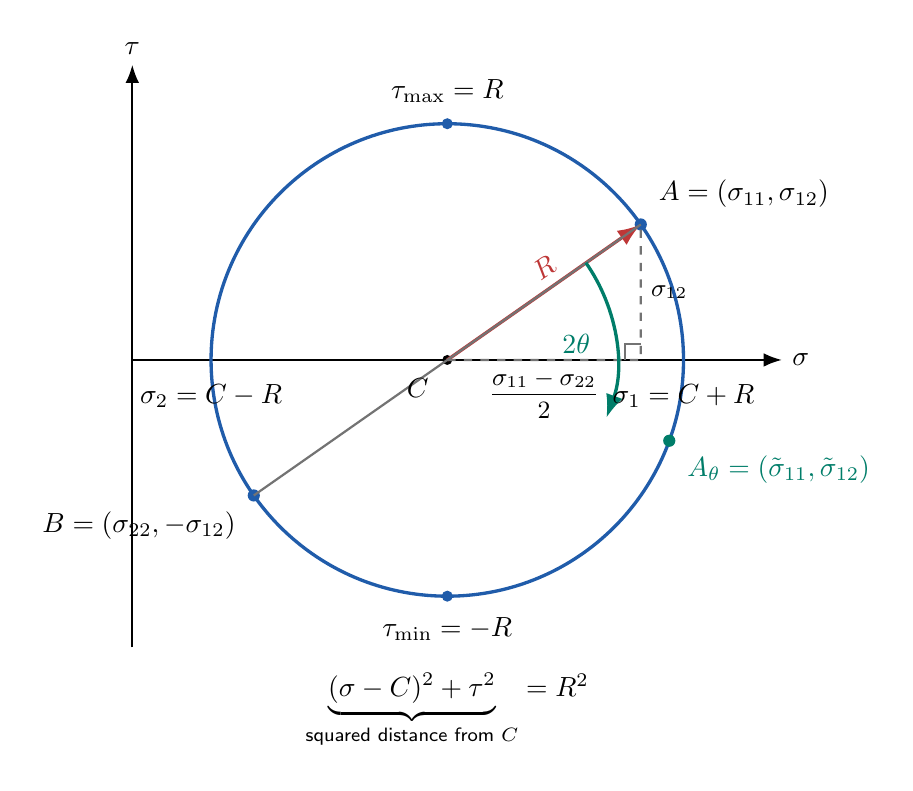
따라서 두 주응력과 최대 면내 전단응력은
\[\sigma_{1,2}=C\pm R, \qquad |\tau_{max}|=R\] 이다. 전단응력축의 양의 방향과 실제 요소의 회전방향은 교재마다 다를 수 있으므로 사용하는 부호 관례를 먼저 확인한다. 실제 요소가 $\theta$만큼 회전하면 Mohr 원에서는 크기가 $2\theta$인 각만큼 이동한다.
5. 연습 문제
문제 1
$\sigma_x=100$ MPa, $\sigma_y=40$ MPa, $\tau_{xy}=0$인 평면응력 상태에서 Mohr 원의 중심을 구하라.
문제 2
문제 1의 Mohr 원 반지름을 구하라.
문제 3
문제 1의 두 주응력을 구하라.
문제 4
실제 요소가 $\theta$만큼 회전할 때 Mohr 원에서는 몇 도 이동하는가?